

|
| Chazin Home | Ca-binding Protein DB | Vanderbilt Home |
|
| Research Description | Publications | Wisdom | Search | ||
| How to contribute | About this page |
The following example is for data acquired on the DRX-600.
REMOVAL OF RESIDUAL HOD SIGNAL:
Although the sample was in D2O,
residual HOD signal was present after processing in the first and last
two planes of the 3D matrix. The first plane is shown below.
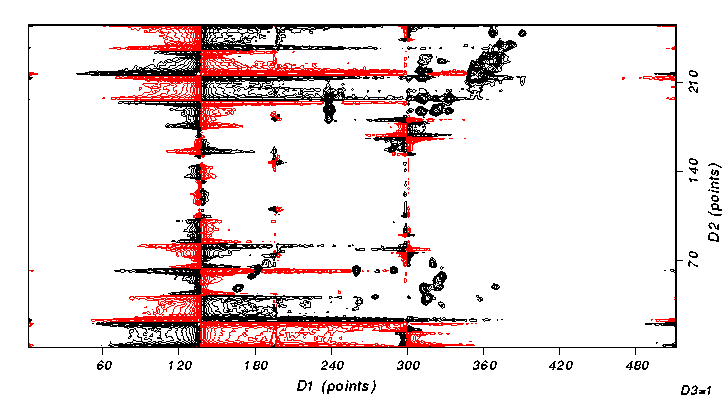
In order to reduce the residual water signal, I followed the following procedure:
a) As this is oversampled data
ft
large first order
phase correction
ph
figure out the
position of the water peak ( i.e. # of points = n)
ift
def phase1 =
(-){ (datsize - n) x 360 }
or {n x 360}
| I had to optimize this value
The data
before and after the above manipulation is shown below:
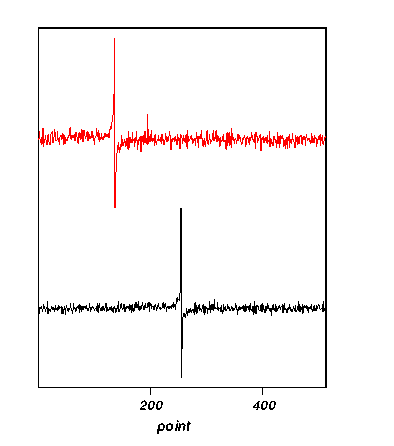
Once the water peak is centered, it can be deconvoluted.
After deconvolution redefine phase1
= (-) (phase1), and perform a phase correction on the
fid.
Now the data is ready for any window
function manipulation etc....
The macro I used for D1 transform
is given below:
c**<rchcchtd2on3_3d1.mac, introduced
cnv to get rid of residual water streak>


cl
cmx
def datype 1
def datsiz 512
def gibbs 0
bld rchcchtd2o3dc.mat 3 512 256
128 0
mat rchcchtd2o3dc.mat w
for pln 1 118
    for row 1 198
       re rchcchtd2o3d.dat
       def datype 1
       def datsiz 512
       ft
       def phase0 0
       def phase1 25992.0    : this is my personal preference, `dft DECIM DSPFVS' is
                             : the other option.
       ph
       ift
       def phase0 0
       def phase1 42480
       ph
       cnv 0 32 1
       def phase0 0
       def phase1 -42480
       ph
       ss 256 90
       zf 512
       ft
       red
       def datype 0
       def datsiz 512
       sto 0 &row &pln
       ty row=&row pln=&pln $
       esc out
       if &out ne 0 break
    next
next
cal half
break:
end
half:
for pln 1 118
      loa 0 1 &pln
      mul .5
      sto 0 1 &pln
      loa 0 2 &pln
      mul .5
      sto 0 2 &pln
next
end
HANDLING 13C
RESONANCES CLOSE TO THE EDGE OF THE SPECTRUM:
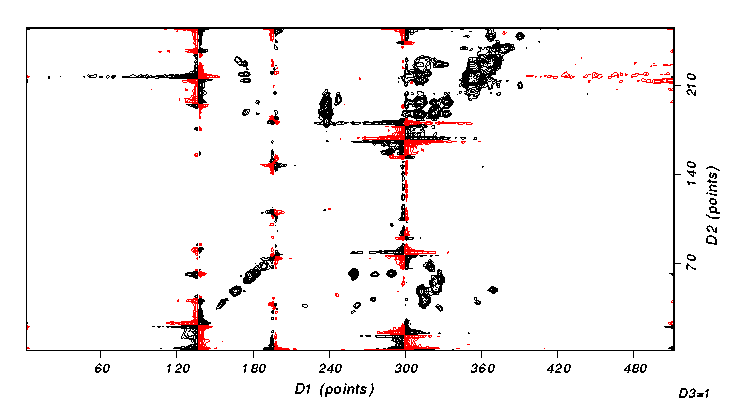
The 1H - 13C projection of the HCCH-TOCSY corresponding to the above processing is shown below.
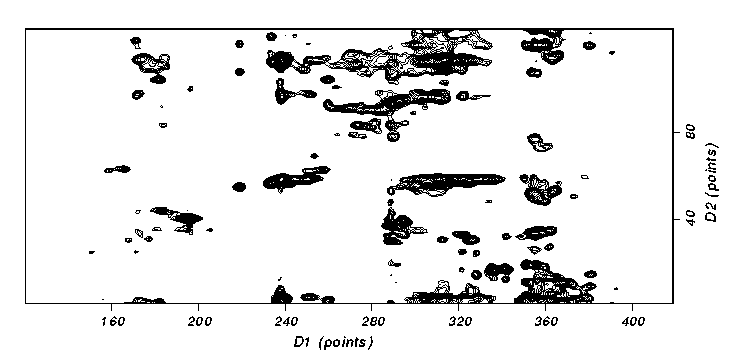
Carbon resonances at the edges can
be taken care off by circular shifting the appropriate
vector in the transformed data,
1H-13C projection is shown below.
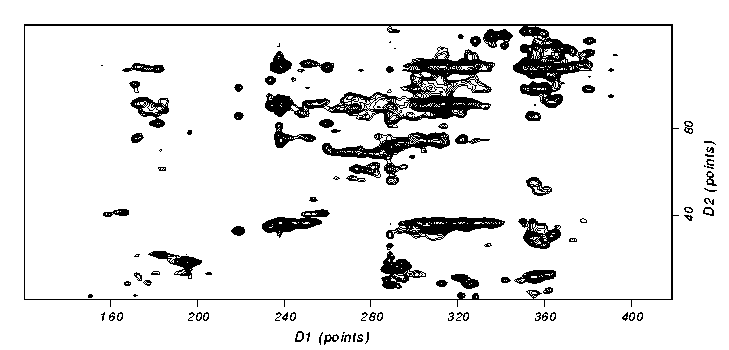
The macro used to circular shift is given below:
c**<csld3.mac>
mat rchcchtd2o3dc.mat w
def ncols 512
def nrows 256
for row 1 &nrows
   for col 1 &ncols
      esc out
      if &out ne 0 break
      loa &col &row 0
      csl 22
      def datype 0
      def datsiz 128
      sto &col &row 0
      ty col=&col row=&row $
   next
next
break:
cmx
end
last edited 06/01/98 by mallika
sastry msastry@scripps.edu.